
Categories
Contracts, Home Buying Guides, Real Estate KnowledgePublished July 30, 2026
What Is an Escalation Clause in Real Estate? (And When to Use One)

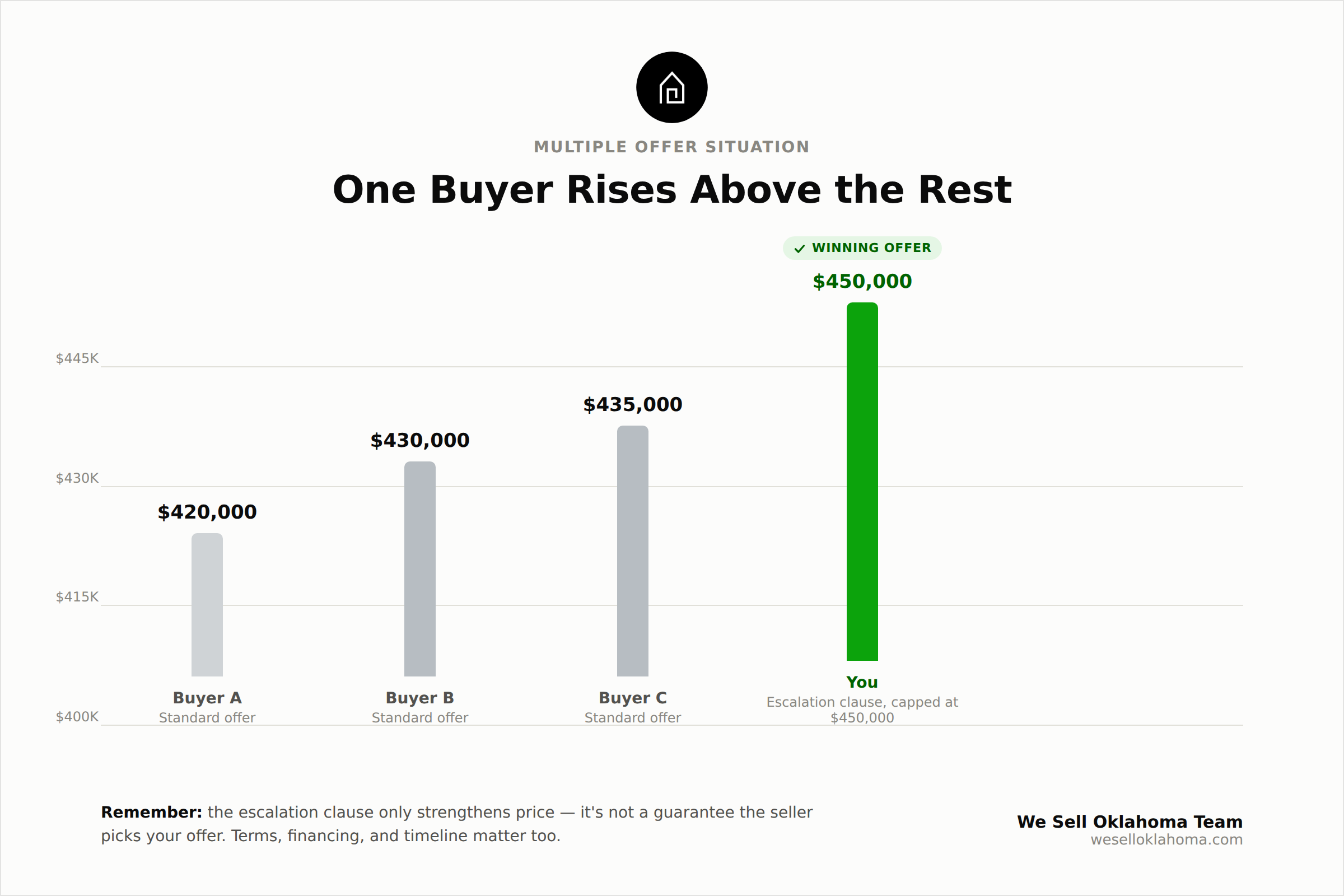
If you've shopped for a home in the OKC metro anywhere between $300,000 and $700,000 lately, you already know the drill: you find "the one," you're not the only one who loves it, and suddenly you're in a bidding war with two, three, sometimes six other buyers. One of the tools we use to help our buyers compete in that exact situation is called an escalation clause.
Here's what it is, how it works, when it makes sense, and — just as important — when it can backfire.
What Is an Escalation Clause?
An escalation clause is a provision you add to your purchase offer that automatically increases your offer price if the seller receives a higher competing offer, up to a maximum amount you set in advance. Instead of guessing what everyone else is offering and hoping you guessed high enough, an escalation clause lets your offer "escalate" itself — automatically beating the competition by a set increment, without you having to submit a brand new offer every time someone else raises theirs.
Every escalation clause boils down to three numbers:
- Your starting offer price – what you'll pay if there's no competition at all
- Your escalation increment – how much your offer jumps above the next-highest offer, often $1,000 to $2,500 at a time
- Your cap – the absolute most you're willing to pay, full stop
How an Escalation Clause Works: A Real-World Example
Let's say you're buying a home in Edmond listed at $425,000. You love it, and you already know it's going to get multiple offers. You submit an offer at $425,000, with an escalation clause that says you'll beat any competing offer by $2,000, up to a maximum of $450,000.
If no other offers come in, you get the home at $425,000 — your starting price, no drama. But if another buyer offers $435,000, your offer automatically escalates to $437,000. And if someone else pushes to $448,000, your offer climbs right up to your $450,000 cap — and that's as far as it goes. Even if another buyer offers $455,000 the next round, you're done. That cap is your line in the sand.
Keep in mind the seller (and their agent) typically requires proof of the competing offer before your escalation kicks in, which is why this tool works best when the listing agent is willing to disclose that a competing offer actually exists.
When Would a Buyer Use an Escalation Clause?
We reach for an escalation clause when a buyer is in a confirmed multiple-offer situation — the listing agent has set an offer deadline, or has already told buyers' agents that multiple offers are in hand. It's also a fit when you genuinely love the home and are willing to stretch for it. This isn't a tool for a house you're lukewarm on; it's for the one you don't want to lose sleep over losing.
An escalation clause is also a smart way to avoid the endless back-and-forth of "highest and best" rounds. Instead of everyone submitting blind final offers and waiting to hear who won, your offer moves in real time without you having to resubmit paperwork every time someone else raises theirs. But none of that works if you don't already know your true ceiling. Before we ever write one of these clauses, we make sure you've talked to your lender and know your comfortable max payment, so you're never chasing a house past what actually makes sense for your budget.
The Benefits of Using an Escalation Clause
The biggest benefit is that it keeps you competitive without overpaying from the start — you're not throwing out your highest number right out of the gate, your offer only climbs as high as it needs to in order to win. It also saves you from decision paralysis. In a fast-moving multiple-offer situation, you don't have time to keep drafting and resubmitting new offers every few hours, and an escalation clause does that negotiating for you in real time.
There's also a psychological benefit on the seller's side: a well-written escalation clause signals that you're a motivated, prepared buyer, which matters to a seller trying to pick the strongest contract, not just the highest number on paper. And because you set your cap in advance, you're protected from getting swept up in bidding-war emotions and offering more than you can actually afford in the heat of the moment.
The Risks of Using an Escalation Clause
Here's the flip side. An escalation clause can tip your hand — by showing your increment and your cap, you're telling the seller exactly how high you're willing to go, and some listing agents will simply counter you right at that number. You may also end up paying more than you would have in a straightforward negotiation. If you turn out to be the only other offer, the seller can see your escalation clause and push your price up close to your max anyway.
Appraisal gaps get real, fast, when you're using an escalation clause. If your escalated price lands well above the home's appraised value, you'll need a plan before you get there — a larger down payment to cover the gap, an appraisal-gap guarantee built into your offer, or at minimum a real conversation with your lender ahead of time. It's also worth knowing that not every seller or listing agent will accept an escalation clause in the first place; some find them too complicated to manage and will simply ask for everyone's straightforward "highest and best" instead. And proof of competing offers isn't always fully transparent — you're often trusting the listing agent's word that a higher offer exists, which is one more reason it matters to work with a buyer's agent who knows the local agents and how they actually operate.
Using an Escalation Clause Does Not Guarantee You'll Win the Bidding War
This is the part buyers need to hear clearly: an escalation clause is a tool, not a guarantee. Sellers aren't required to accept the highest price, and in our experience, they frequently weigh other factors just as heavily as the number on the page, including:
- Financing type (cash and conventional offers are typically viewed as stronger than FHA or VA in a competitive situation)
- Size of the earnest money deposit
- Flexibility on closing date and possession
- Number and type of contingencies built into the offer
- Whether the buyer has already been fully underwritten, not just pre-qualified
We've seen buyers lose a home to a lower offer simply because the other buyer waived an inspection contingency, offered a faster close, or came in with cash. An escalation clause only addresses price — it does nothing to strengthen the rest of your offer. If you're serious about winning a multiple-offer situation, price is just one piece of the strategy.
Our Take: Should You Use One?
We use escalation clauses strategically with our buyers, not automatically. Before we ever include one in an offer, we make sure you know your real financial ceiling, we've talked through the appraisal-gap risk together, and we've built the rest of your offer to be as strong as it can be — not just leaning on price alone.
If you're getting ready to buy in the $300,000–$700,000 range anywhere in the OKC metro and you want a strategy that actually wins homes, not just one that sounds good on paper, let's talk before you write your next offer.
Ready to make a winning offer? Connect with our team and let's build your offer strategy together.

Emily Mathews
Team Leader | We Sell Oklahoma Team || LRE Realty
or another way