
Categories
ContractsPublished June 17, 2026
Appraisal Higher Than Your Offer? Here's What It Means for Oklahoma Buyers

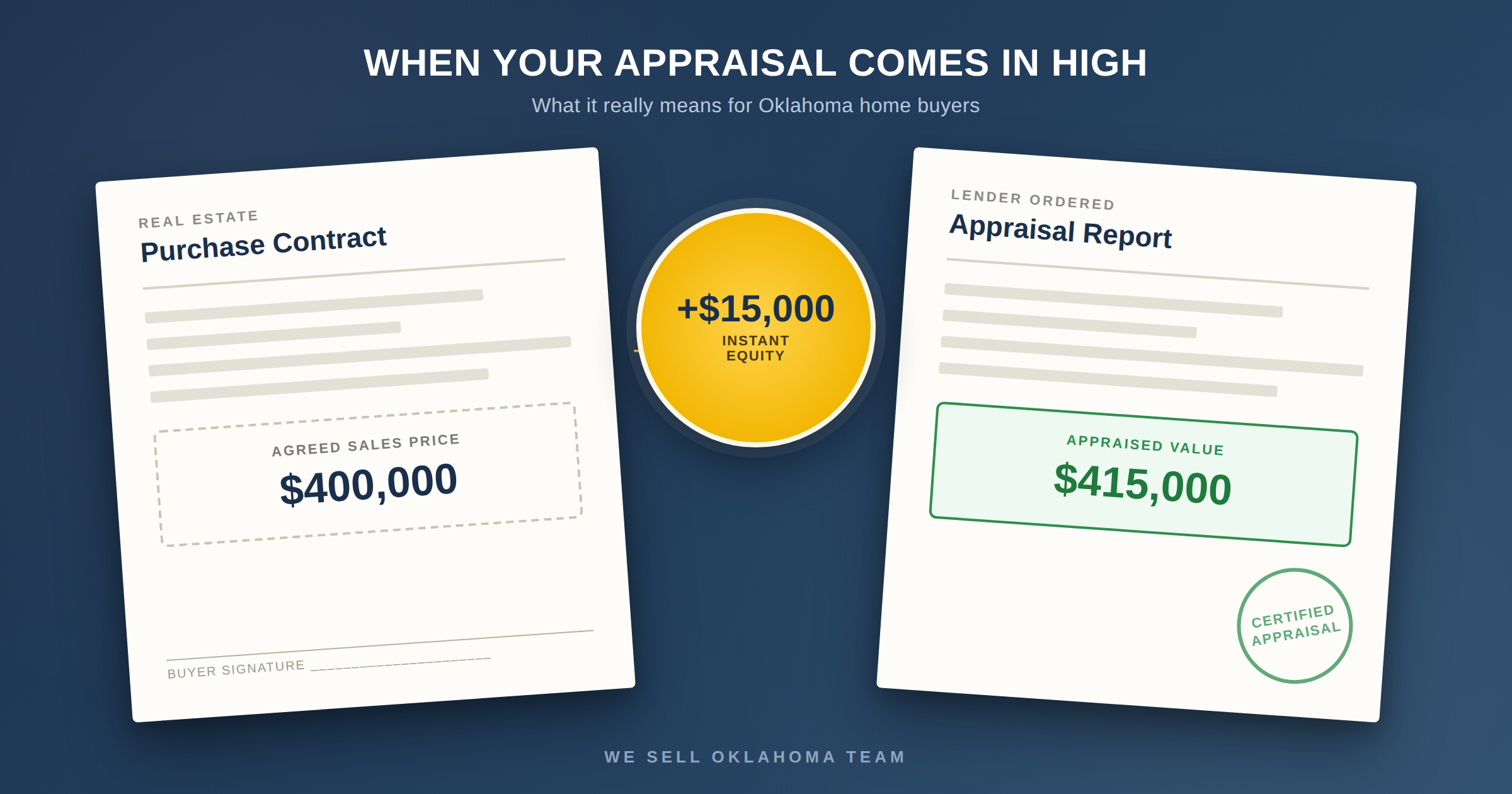
If you're buying a home in Oklahoma and your lender just called with good news about the appraisal, you might be wondering what it actually means for you. Here's the short version: a high appraisal is good news, and it doesn't cost you a dime more.
Let's break down exactly what happens when your appraisal value comes in above your contract price — and, since it's worth knowing both sides of the coin, what happens when it comes in low, too.
First, What Is an Appraisal?
Once you're under contract on a home and financing with a mortgage, your lender orders an appraisal. This isn't the same as a home inspection — an appraisal is ordered specifically by your lender to determine the actual dollar value of the home you're buying.
Here's why it matters to the bank: they want to make sure they're not lending you more money than the home is actually worth. If you were to default on the loan, the bank needs to know the house is solid collateral. An appraisal typically costs between $400–$800, and if you're paying cash, it's usually not required at all.
Here's the Part Most Buyers Don't Know: The Appraisal Is for You and Your Lender — Not the Seller
This is the piece I want every buyer to understand clearly:
- The appraisal is ordered by your lender, for your lender's benefit and yours.
- The seller does not see your appraisal value. They aren't privy to that number at all.
- Because the seller never sees it, a high appraisal has zero impact on your negotiated purchase price.
So what does that mean in practice?
If the Appraisal Comes in Higher Than Your Contract Price
Let's say you agreed to buy a home for $400,000, and the appraisal comes back at $415,000. That $15,000 gap doesn't go to the seller, and you don't owe anyone a penny more.
You just picked up $15,000 in instant equity — before you've even moved in.
Here's why that happens:
- Your purchase price is locked in by the contract you and the seller already signed.
- The appraisal simply confirms (or in this case, exceeds) that value for the lender's purposes.
- Since the seller never sees the appraisal number, there's nothing to renegotiate and no reason the price would change.
- The difference between what you're paying and what the home is actually worth becomes equity that's yours from day one.
Think of it this way: if you bought a car for $20,000 and later found out it was actually worth $23,000, you wouldn't expect to pay the seller an extra $3,000 — you'd just be glad you got a great deal. A high appraisal works the same way. It's simply confirmation that you made a smart purchase.
Bottom line for buyers: A high appraisal is one of those rare moments in a real estate transaction where there's genuinely nothing for you to do. No negotiation, no paperwork, no added cost. Just good news and a little extra equity cushion in your new home.
What Happens If the Appraisal Comes in Below the Contract Price?
Now, for the other side of this. In most cases, the appraisal lands at or very near your agreed contract price — especially when your Realtor has provided solid comparable sales data before you ever made an offer. But occasionally, the appraised value comes in lower than what you agreed to pay.
When that happens, it creates what's often called an "appraisal gap," and you and your Realtor will need to go back to the negotiating table with the seller. Generally, buyers have a few options:
- Renegotiate the price. Your Realtor can present the appraisal to the seller and ask them to lower the sales price to match the appraised value.
- Split the difference. Sometimes buyer and seller agree to meet in the middle rather than one side absorbing the entire gap.
- Pay the difference in cash. If you want the home badly enough and the seller won't budge, you can choose to bring additional cash to closing to cover the gap between the loan amount and the purchase price.
- Challenge the appraisal. In some cases, your lender can request a reconsideration of value if there's evidence the appraisal was inaccurate or missed relevant comparable sales.
- Walk away. If your contract includes an appraisal contingency, you may have the right to cancel the contract and get your earnest money back if you and the seller can't reach an agreement.
A low appraisal isn't the end of the world, but it does require a plan — and it's exactly why having an experienced Realtor in your corner matters. We're there to negotiate on your behalf and walk you through every option so you can make the choice that's right for you and your budget.
The Takeaway
A high appraisal means instant equity and nothing owed. A low appraisal means it's time to negotiate, and you've got options. Either way, you're not navigating it alone — that's exactly what we're here for.
Have questions about the appraisal process or where to start on your Oklahoma home search? Reach out to the We Sell Oklahoma Team — we'd love to help.

Emily Mathews
Team Leader | We Sell Oklahoma Team || LRE Realty
or another way